
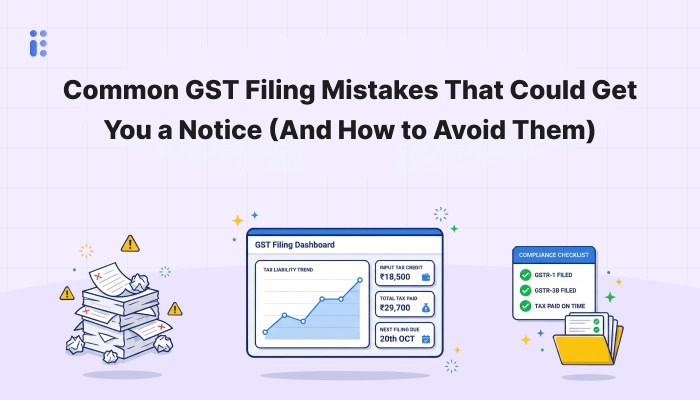
No business owner wants to receive a GST notice. Yet, many notices aren’t triggered by fraud or large-scale issues - they’re caused by small mismatches, overlooked entries, or inconsistent records. GST compliance today is system-driven. Returns are cross-verified automatically. And if your numbers don’t match the system’s expectations, it flags discrepancies quickly.
Here are the most common mistakes that create problems.
If your outward supplies declared in GSTR-1 don’t match the summary reported in GSTR-3B, it creates an automatic red flag.
This usually happens due to:
Avoid it: Use automated reports that generate both returns from the same data source.
Claiming ITC on invoices that don’t appear in GSTR-2B - or from vendors who haven’t filed returns - can trigger scrutiny.
Many businesses fail to reconcile purchase records properly.
Avoid it: Regular monthly ITC reconciliation instead of last-minute quarterly adjustments.
Even a small delay can result in penalties and interest charges.
Businesses often postpone filing because their books aren’t finalised.
Avoid it: Keep real-time records instead of scrambling before due dates.
Manual record-keeping increases the chances of skipped invoice entries or double reporting.
Over-reporting increases tax liability. Under-reporting invites notices.
Sometimes notices are simple clarification requests. Ignoring them escalates the issue unnecessarily.
GST compliance today is data-driven. If your invoicing and expense records are clean, filing becomes routine.
With Billite, reports are generated directly from your invoicing data - reducing mismatches and ensuring consistent numbers across returns.
Compliance doesn’t have to be stressful. It just needs to be organised.
Discover how accounting software helps businesses improve cash flow, reduce errors, simplify GST compliance, and scale e...
Read More