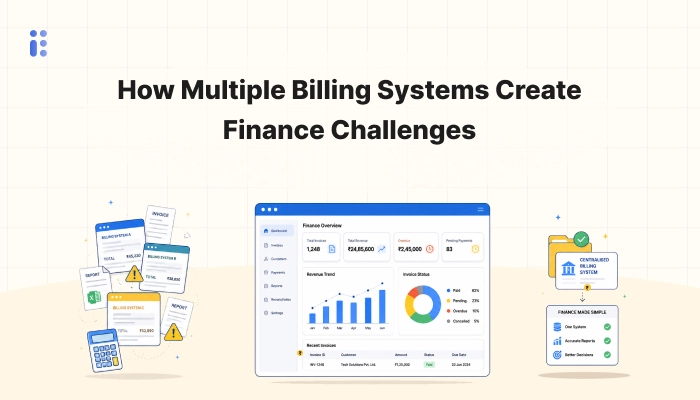

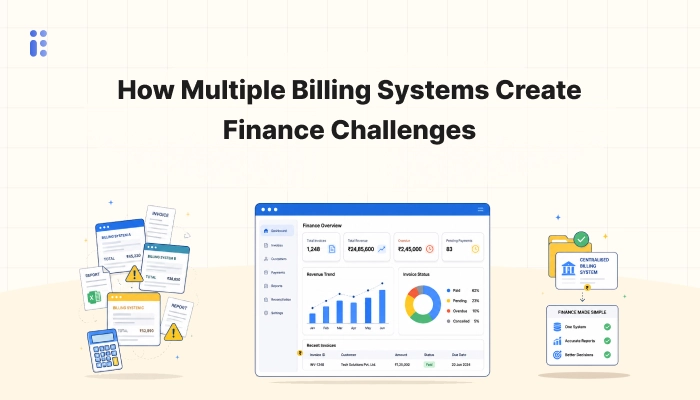
For a lot of small businesses, billing doesn’t really "live" in one place. An invoice might be created in Excel. The payment update comes on WhatsApp. A revised amount is discussed over call. The client’s GSTIN is sitting in an old email thread. And the final status of whether the invoice is paid or pending is known only to one person in the team.
On the surface, this doesnt look like a major problem. Work is still moving, invoices are still going out, and money is still coming in. But over time, this kind of fragmented setup creates a very specific kind of operational drag - one that shows up in missed follow-ups, GST confusion, reporting gaps, and cash flow blind spots.
Most businesses don’t struggle because they can’t create an invoice. They struggle because billing is connected to too many other moving parts:
When each of these sits in a different place, the billing process becomes dependent on memory, back-and-forth, and manual checking. That’s when small errors start creeping in. A customer’s GSTIN is entered incorrectly because the latest one wasn’t updated in the sheet. A payment reminder doesn’t go out because there’s no central pending invoice view. An invoice gets duplicated or skipped because numbering is being managed manually. A CA asks for sales data and the team has to pull it from three different sources before anything can be reconciled. None of this feels dramatic in isolation. But together, it creates friction every single month.
One of the biggest side effects of a scattered billing setup is that collections become harder to manage. Not because clients don’t want to pay - but because the business itself doesn’t have a clean, current picture of what’s due, what’s overdue, and what’s already settled. If invoice records are in one place and payment confirmations are in another, someone always has to manually cross-check status before following up. That usually means reminders go late, or don’t go at all. And once payment tracking becomes inconsistent, cash flow visibility starts weakening too. You don’t just lose process efficiency. You lose confidence in the numbers.
A lot of GST-related stress isn’t caused by GST itself. It’s caused by poor record-keeping through the month. When billing data is spread across multiple files and conversations, month-end becomes a clean-up exercise. Teams have to verify invoice values, tax breakups, customer GST details, and payment status before accounts can be finalised properly. That’s time that could have been avoided if the system itself was structured from the beginning.
When invoices, customer records, payment reminders, and expense tracking sit in one place:
That’s the kind of shift Billite is built for. Billite is not trying to behave like a bloated finance suite for large enterprises. It’s built for the way small and mid-sized Indian businesses actually operate - where invoicing, expense tracking, reminders, customer management, and GST-ready records need to work together without becoming another operational burden.
Billing problems usually don’t begin with one bad invoice. They begin when the billing process is spread across too many places, with no single system tying it all together. And once that happens, finance starts becoming reactive instead of structured.
If your team is still piecing together invoices, payments, and customer records from different tools every month, the problem is not effort. It’s the system. Billite helps bring that system together - so billing, collections, customer data, and compliance don’t have to be managed like separate tasks.
Discover how accounting software helps businesses improve cash flow, reduce errors, simplify GST compliance, and scale e...
Read More